AMF & Synchronisation Panels
Auto-mains-failure and multi-DG synchronising panels with load sharing and load-dependent start/stop.
About AMF & Synchronisation Panels
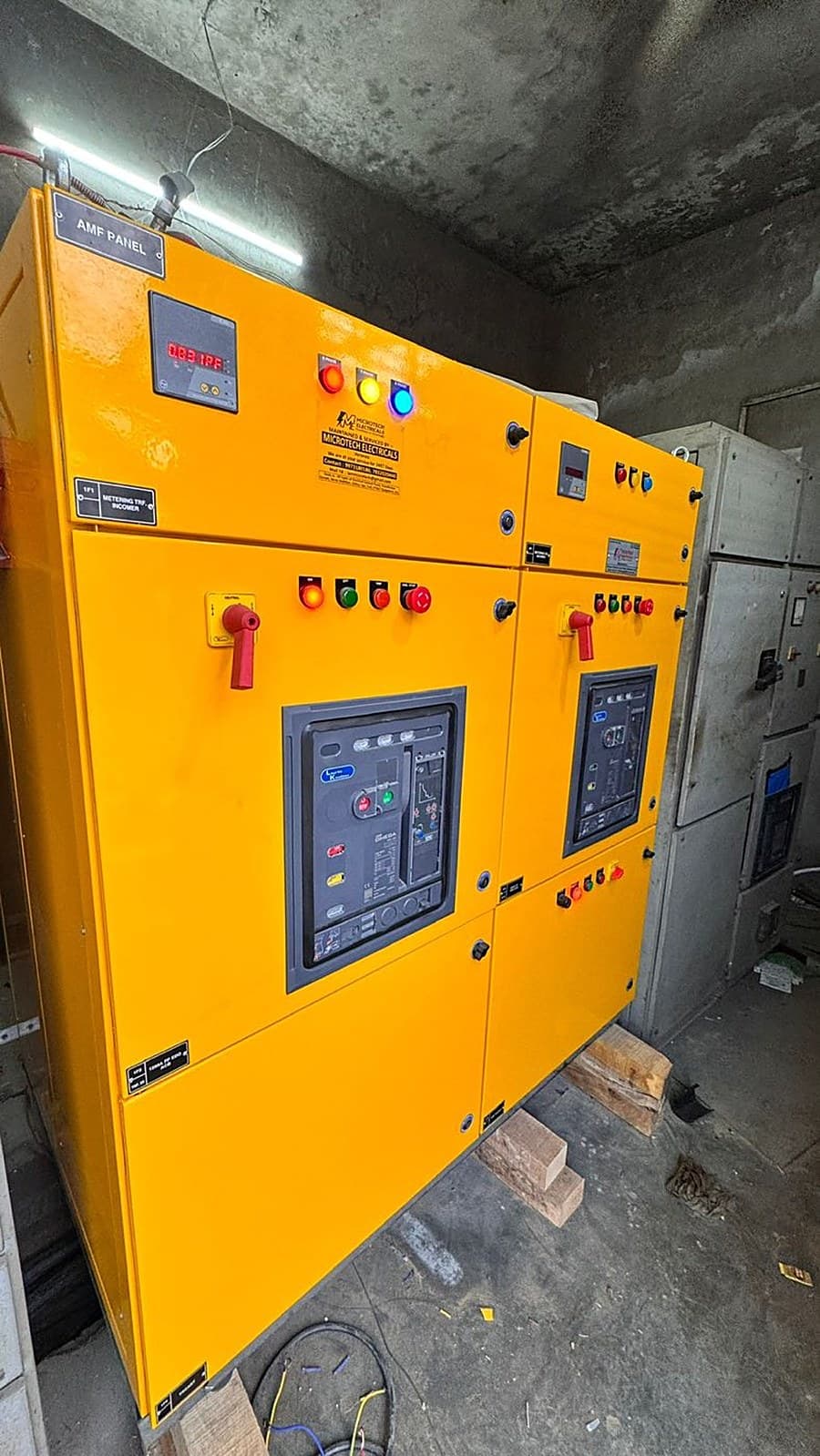
An auto mains failure (AMF) panel watches the utility supply and, when it fails or goes out of limits, starts the DG set, waits for healthy voltage and frequency, and transfers the load. When mains returns and stays stable, it transfers back and runs the engine through a cool-down before stopping — with no operator involved.
A synchronising panel lets two or more DG sets run in parallel on a common busbar. Before an incoming set's breaker closes, its voltage, frequency and phase angle are matched to the bus; once on line, the sets share kW and kVAr in proportion to their ratings. Load-dependent start/stop brings sets on as demand rises and drops them when it falls, saving fuel and engine hours.
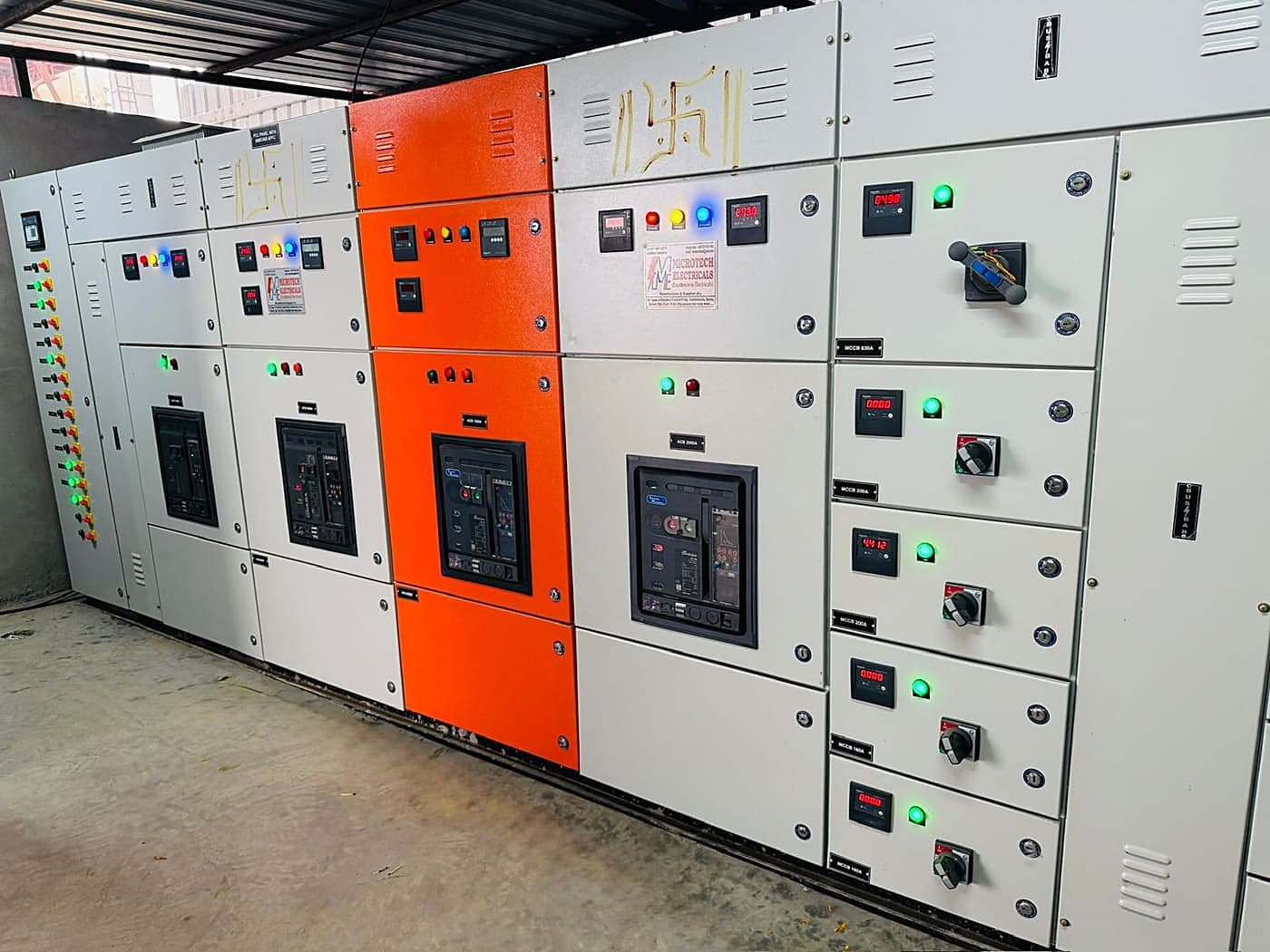
Microtech designs and builds AMF and synchronisation panels at its Varanasi and Lucknow facilities, using Lauritz & Knudsen and Schneider Electric switchgear for the changeover and DG breakers, with genset controllers such as DSE or CAT EMCP to suit the set. Because we also supply and service DG sets, the panel and the set can be commissioned together by one team.
Key specifications
| AMF functions | Mains sensing, auto start, changeover, retransfer and cool-down with adjustable timers |
|---|---|
| Changeover devices | Motorised ACB/MCCB pair with electrical and mechanical interlock, or 4-pole contactors (e.g. L&K MCX, 18–900 A AC-1) |
| Synchronisation | 2–8 DG sets on a common bus; voltage, frequency and phase-angle matching before closing |
| Load sharing | Active (kW) and reactive (kVAr) sharing between sets |
| Load management | Load-dependent start/stop; base-load and peak-lopping modes |
| Mains paralleling | Where permitted by the utility, with mains protection |
| Controllers | DSE or CAT EMCP genset controllers, chosen to suit the set |
| Panel standard | IS/IEC 61439-1 & 61439-2 |
Features & benefits
- Unattended changeover on mains failure and automatic return on restoration
- Interlocked changeover so mains and DG can never be paralleled unintentionally
- Adjustable start delay, warm-up, transfer and cool-down timers
- Equal kW and kVAr sharing across sets of the same or different ratings
- Load-dependent start/stop to match running sets to demand
- Event and alarm logging on the genset controller
- Panel and DG set commissioned together by the same team
Where it’s used
- Hospitals and nursing homes
- Hotels, malls and commercial complexes
- Factories with continuous process loads
- Data centres and telecom sites
- Residential townships and high-rise buildings
- Water supply and pumping stations
Standards & compliance
AMF & Synchronisation Panels — FAQs
What is the difference between an AMF panel and an ATS?
An automatic transfer switch only moves the load between two sources. An AMF panel adds the DG control: it detects mains failure, starts and stops the engine, monitors its protections and then operates the changeover. Most single-DG sites need the full AMF function.
When should I synchronise DG sets instead of running one large set?
Several smaller synchronised sets give redundancy — the site keeps running if one set trips or is under maintenance — and let you run only as many sets as the load needs, which keeps engines better loaded and saves fuel. One large set is simpler where load is steady and redundancy is not required.
Can you synchronise sets of different makes or ratings?
Often yes, provided each set has a governor and AVR that accept load-sharing control. Sharing is in proportion to rating. We review the engine and alternator controls on site before confirming the scheme.
Can an existing manual changeover be converted to AMF?
In most cases yes. We add the AMF controller, motorised changeover devices and wiring to the DG starting circuit. A site survey confirms whether the existing switchgear can be reused.